
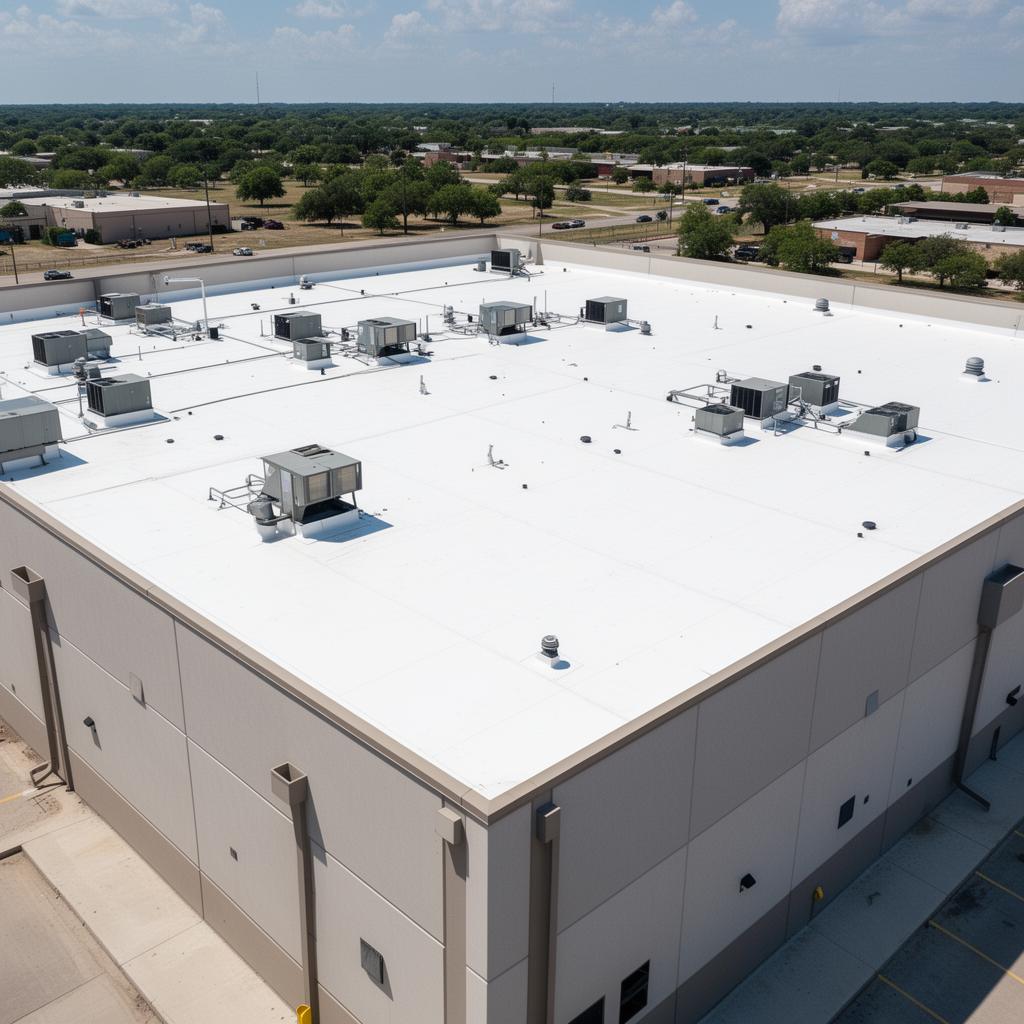
Commercial PVC roofing for grease and chemical exposure.
Single-ply membrane built to resist kitchen grease, oils, and chemical exposure — with the same welded-seam reliability as TPO.
Not every commercial roof lives an easy life. Restaurant kitchen exhaust, grease trap venting, and industrial chemical exposure will degrade a standard TPO membrane over time. PVC single-ply roofing is formulated specifically to resist that kind of exposure, and it's worth understanding the difference before your building's next roof decision.
 P91 Zero-Leak Guarantee
What we deliver
- Chemical- and grease-resistant membrane chemistry
- 45, 50, 60, and 80 mil thickness options
- Hot-air welded seams, probe-tested before handover
- Reflective surface for UV and heat performance
- Right fit for restaurant, food service, and industrial roofs
- Tear-off or recover based on contamination and moisture findings
Why PVC where grease and chemicals are a factor
PVC's polymer chemistry resists petroleum-based grease, oils, and many industrial chemicals in ways that standard TPO cannot. Kitchen exhaust fans deposit grease directly onto roof surfaces around hoods and curbs, and over years that grease will soften and break down a TPO membrane's surface. PVC is the industry-standard specification for restaurant rooftops, food processing plants, and any building with chemical exhaust or solvent exposure for exactly this reason.
Membrane thickness and where 80 mil pays off
PVC comes in 45, 50, 60, and 80 mil sheets. We baseline most commercial specs at 60 mil, and step up to 80 mil around kitchen exhaust zones, grease trap venting, heavily trafficked service areas, or anywhere the roof will see more wear than a typical flat roof deck. The extra thickness buys puncture and abrasion resistance in exactly the spots that fail first.
Welding, flashing, and getting the details right
PVC seams are hot-air welded, similar to TPO, but the material's melt characteristics differ enough that welding equipment and technique need to be dialed in specifically for PVC — a weld that looks acceptable can still fail a probe test if temperature or overlap was off. We flash penetrations, curbs, and kitchen exhaust hoods with the same welded PVC detailing as the field membrane, since those are the areas that see the heaviest grease and heat exposure.
Tear-off vs. recover on grease-contaminated roofs
A recover is only appropriate over a clean, dry, structurally sound existing roof. If the existing membrane or insulation has absorbed grease or moisture, a recover just seals that contamination under the new system, so we specify tear-off in those cases even though it costs more upfront. We assess this on-site, not from a photo or a phone call.
Planning around an operating kitchen or plant
Restaurants and food service buildings usually can't shut down for a roof project, so we sequence PVC work by section, coordinate around hood and exhaust access, and keep drains and equipment operational throughout. For multi-location operators, we can phase the project location by location and structure billing around each site's completion.
FAQ
Why choose PVC instead of TPO for a restaurant or industrial roof?+
PVC single-ply membrane resists grease, oils, and many chemical compounds significantly better than TPO, which is why it's the standard specification for restaurant kitchen exhaust areas, food processing facilities, and buildings near chemical exposure or heavy solvent use. TPO can degrade when exposed to petroleum-based grease over time; PVC's chemistry doesn't have that vulnerability.
What membrane thickness do you install for PVC roofs?+
PVC is available in 45, 50, 60, and 80 mil thicknesses. For most commercial buildings we specify 60 mil as the baseline, moving to 80 mil for high-grease kitchen exhaust zones, heavy foot traffic areas, or roofs expected to carry a long service life without recover.
How are PVC seams sealed differently from other membranes?+
Like TPO, PVC uses hot-air welding to fuse seams into a single continuous sheet rather than adhesive. PVC's chemistry welds slightly differently than TPO's and requires trained technicians running properly calibrated equipment; a seam that looks fine visually can still fail a probe test if the weld temperature or speed was off. We probe-test every seam before turnover.
Does PVC handle Houston's UV exposure and heat as well as TPO?+
Yes. PVC membranes are formulated with UV stabilizers and, like TPO, are typically installed in a reflective white or light color that reduces rooftop heat gain. Long-term UV performance is comparable to TPO when the membrane is properly detailed and maintained.
Can PVC roofing be installed as a recover, or does it need a full tear-off?+
It depends on the condition of the existing roof. A recover is possible over a sound, dry existing membrane and insulation. Grease-contaminated existing roofing or wet insulation typically requires tear-off, since covering contaminated or saturated materials just carries the problem forward under the new membrane.
What does PVC roofing cost compared to TPO?+
PVC generally costs more than TPO per square foot due to raw material and manufacturing differences, but for grease exposure or chemical exposure applications it lasts significantly longer and requires fewer repairs, which usually makes it the lower total-cost option over the roof's service life. We price based on an on-site assessment, not a phone estimate.
Planning a commercial roof project?
Assessment, condition report, and a phased budget you can take to ownership. Fully insured crews, 5-year workmanship warranty.