The right roof isn't always the most expensive one.
It's the one that fits your home — and how long you'll stay. A new roof is the largest thing anyone sees when they look at your home. It should reflect the quality that's already inside it — and last at least as long as you plan to live there. We'll help you get both right.
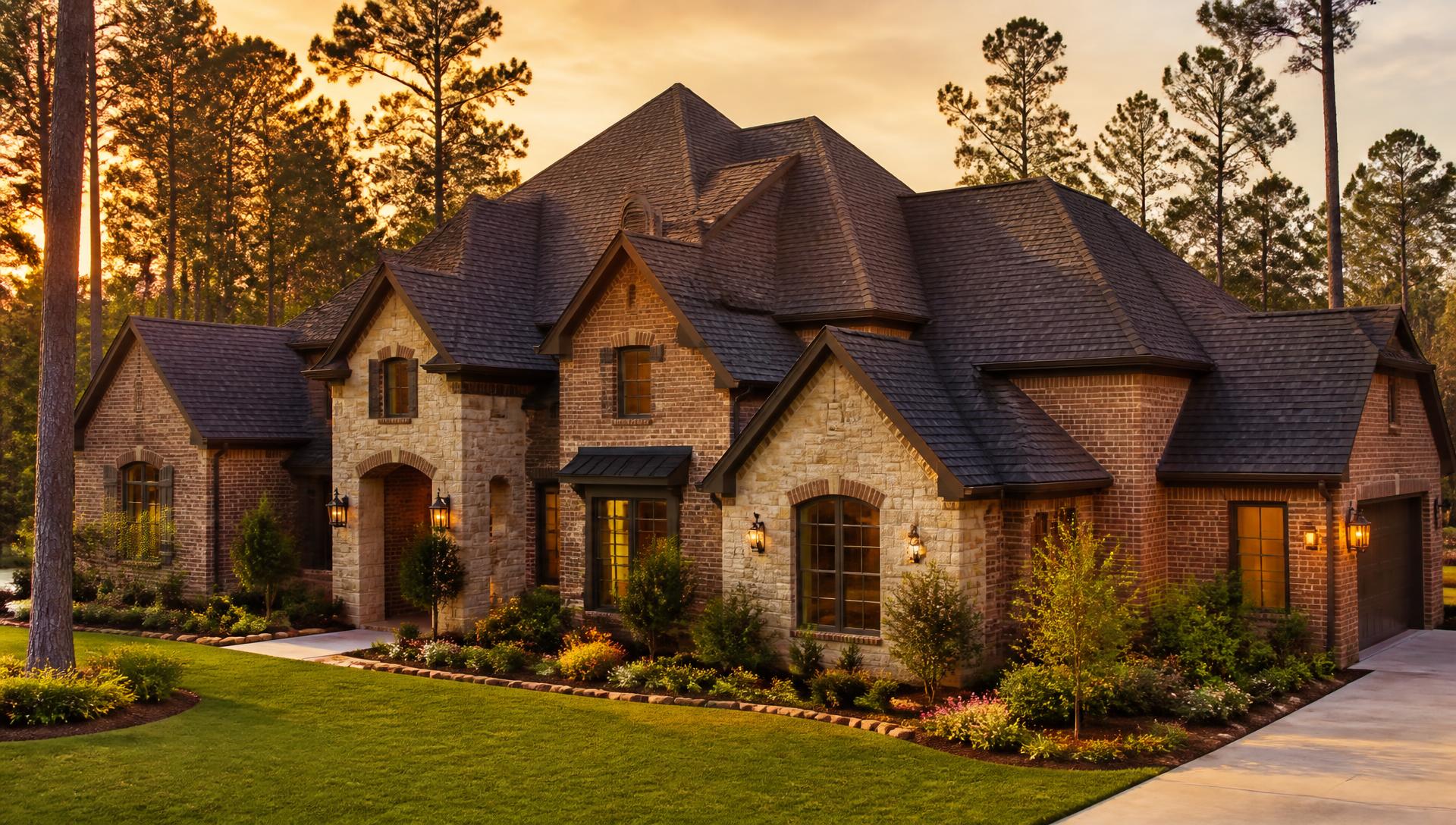
Your home has already told you what quality level it's built to — you just have to look. A 6-inch baseboard instead of a builder-grade 3-inch. A Viking or Wolf range in the kitchen. Full seamless gutters and finished fascia. Solid-core doors. These are the "premium finish" signals, and the roof is meant to be the crown that matches them — not the one place the quality drops off.
The opposite is just as true: if your home is a well-kept builder-grade build, a beautiful architectural shingle may be exactly right, and spending up to slate would be money you'll never see again.
Most roofers open with a product. We open with your home and your timeline — then give you a straight recommendation. You always make the final call.
"We'll tell you what we'd put on our own home."
Every replacement starts with a free inspection and a plain-English recommendation from a P91 roof technician — the tradeoffs, the numbers, and what fits your plans. No pressure, no jargon.
A 2-minute walk-through
Look around. Your home is telling you what roof it wants.
Walk your home and check what you see. The more you check, the more your home leans toward a premium or Class 4 / algae-resistant roof to match. There's no wrong score — it's a starting point for the conversation with your technician.
You checked 0 of 6
The higher your count, the more a premium, algae-resistant, or Class 4 roof helps your home hold its value and look right on the street. Your P91 technician will translate this into specific product options at your inspection.
Curb appeal is a real asset
In The Woodlands, your roof matches your neighborhood.
On a premium street, the roof line is part of the neighborhood's look — and buyers, appraisers, and even the HOA notice when one home breaks the pattern. What "right" looks like changes by community:
Carlton Woods
The top tier. Expect shaped/designer premium shingles, slate, or metal, almost always with algae-resistant protection. The roof is a statement, and it's held to it.
Sterling Ridge, Cochran's Crossing & the golf-course villages
A genuine mix: slate, standing-seam metal, mixed-material roofs, and premium dimensional shingles side by side. Matching the caliber of your street matters more than any single "best" shingle.
Established builder-grade neighborhoods
Many homes wear quality architectural shingles, and a well-chosen algae-resistant architectural roof keeps the whole street looking sharp.
The through-line: match the roof to the value and the vernacular of your block. We know these neighborhoods — we'll tell you what fits yours.
The real decision
Three upgrades worth understanding — and they're not the same thing.
Homeowners hear "Class 4" and "algae-resistant" used interchangeably. They're not — and knowing the difference is how you get exactly what your home needs without paying for what it doesn't.
Algae Resistance
The black-streak defense
Those dark streaks on shaded roofs are blue-green algae (Gloeocapsa magma) — cosmetic, but they age a premium home fast and drag down curb appeal. Algae-resistant shingles use copper or zinc granules that release slowly to stop streaking before it starts. As a GAF Certified contractor, P91 installs lines like GAF Timberline with StainGuard Plus, carrying a limited algae warranty up to 25 years on qualifying products.
Best if: your home is shaded, near trees or water, or in a neighborhood where clean curb appeal protects home value.
Class 4 Impact Resistance
The highest impact rating · UL 2218
Earns the top UL 2218 rating — survives a 2-inch steel ball dropped from 20 feet, twice in the same spot, without cracking. Many Texas insurers offer a homeowners premium discount for a verified Class 4 roof (varies by carrier — we help you document it).
Best if: you're staying long-term and want the toughest hail defense plus the potential insurance savings over many years.
Class 4 is an impact rating — it doesn't automatically include algae resistance. Premium lines often bundle both features, but they're separate specs. We'll confirm what's included on any product we recommend.
Premium / Designer & Non-Asphalt
Slate, metal, shaped shingles
Shaped "designer" shingles, natural or synthetic slate, and standing-seam metal exist to match high-end homes and neighborhoods where standard shingles would look out of place. Often the right answer in Carlton Woods and the golf-course villages.
Best if: your home and street sit at the premium end, and the roof needs to reflect that.
Many premium roofs combine all three — a shaped, algae-resistant, Class 4 system. There's no universal winner, and any roofer who claims one is selling, not advising. Your P91 technician will match the combination to your home, your street, and how long you're staying.
Getting your value out
A 15-year plan deserves a 15-year roof.
The simplest test of a good replacement: does the roof outlast your time in the home? Buy too little roof for a long stay and you'll replace it twice. Over-buy for a short stay and you hand that value to the next owner.
Staying 20+ years?
Lean to the most durable system your budget allows — you'll live in every dollar of that longevity.
Staying 7–15 years?
The sweet spot where Class 4's insurance discount plus durability often earns its premium back before you sell.
Selling within a few years?
A quality algae-resistant architectural roof protects the home and the sale without over-investing in payback you won't collect.
Not sure?
Normal — plans change. We'll weigh it both ways so you're covered either direction.
The honest part most roofers skip
A new roof from insurance isn't as automatic as it used to be.
Storm-chasers love to promise "we'll get insurance to buy your roof." The 2026 reality is more complicated — and worth understanding before you file, because a claim you don't need can cost you more than it pays.
Your deductible is bigger than you think.
Most Texas homeowners assume a flat 1% deductible. In practice, wind and hail deductibles are commonly 2% of your home's insured dwelling value — and some policies now carry a separate, higher roof-specific deductible or "roof payment schedule." On a home insured at $1 million, a 2% wind/hail deductible is $20,000 out of pocket before insurance pays a dollar. That deductible tracks your home's insured value, not the roof's price.
RCV vs. ACV changes everything (and the trend is toward ACV).
This one line on your policy decides whether you get a new roof or a depreciated payout — and carriers are increasingly shifting to the one that pays you less.
What RCV and ACV actually mean — and where to find yours on your policy+
RCV (Replacement Cost Value): Pays what a comparable new roof costs today, minus your deductible. This is what most homeowners assume they have.
ACV (Actual Cash Value): Pays the depreciated value — replacement cost minus wear for the roof's age. A 15-year-old roof on a $20,000 replacement scope might pay out only a fraction, leaving you to cover the rest.
The 2026 trend: To control storm losses, many carriers are moving older roofs to ACV or attaching a "roof payment schedule" endorsement that shrinks the payout as the roof ages — sometimes kicking in as early as year 10–15. Some carriers quietly attach these as riders to what still looks like an RCV policy on the surface.
Where to look on your policy:
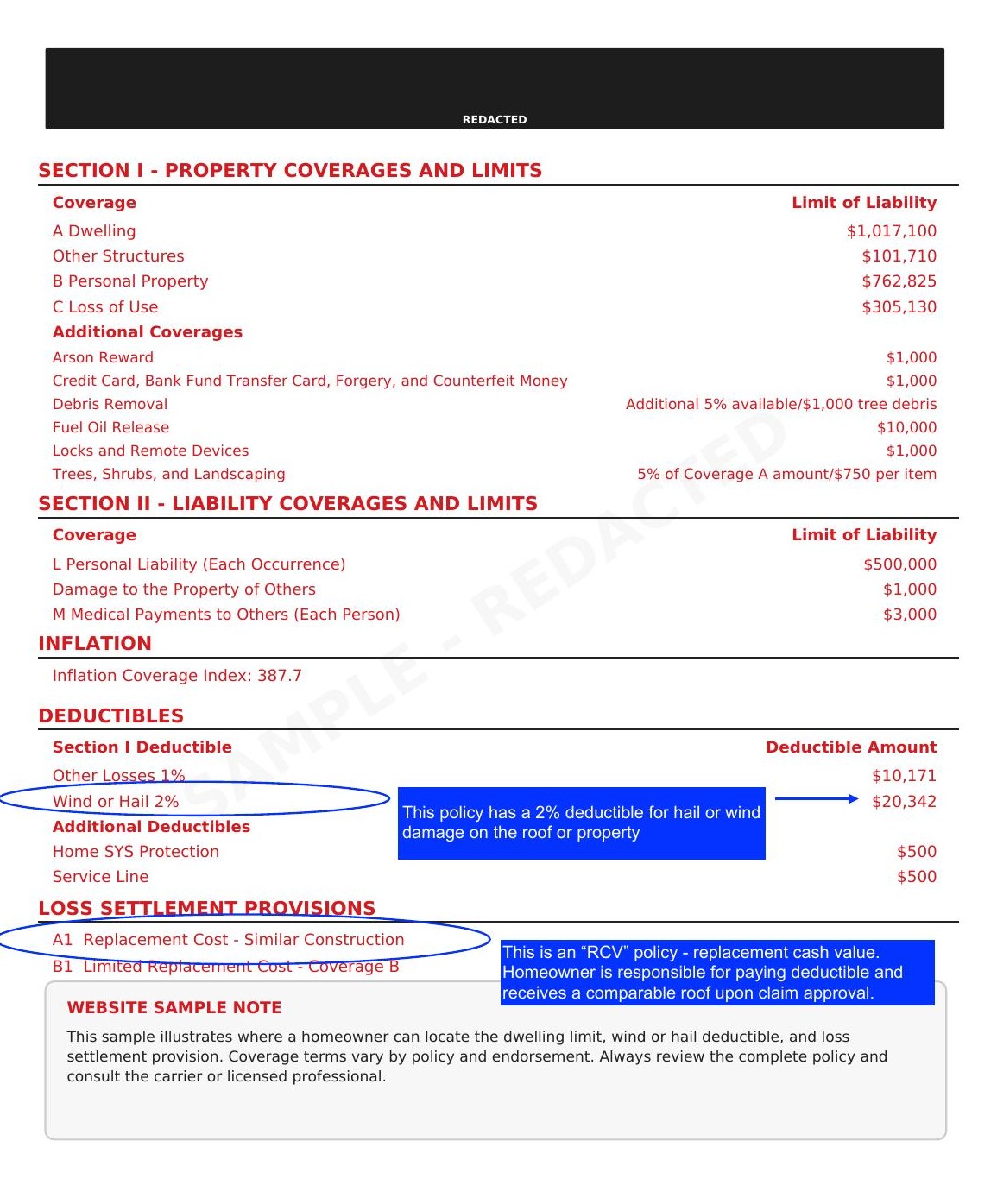
Open your Declarations Page (the 2–3 page summary your insurer sends at each renewal). Look for:
"Loss Settlement Provisions" or "Settlement" — this is where RCV or ACV is stated. It may say “Replacement Cost,” “Actual Cash Value,” or reference a schedule.
"Section I Deductibles" — look for a separate “Wind or Hail” line. If it says 2% (or higher), that percentage applies to your Coverage A / Dwelling amount, not the roof cost.
"Forms, Options, and Endorsements" — usually page 3 — scan for any roof-related rider or endorsement that modifies settlement terms.
Sample redacted State Farm Declarations Page (Page 2 of 3), illustrative only. Your policy layout may differ by carrier. This is not a binder, quote, or proof of coverage. State Farm is a registered trademark of its owner. The key: find your Loss Settlement Provision (RCV or ACV?) and your Wind or Hail Deductible (1%? 2%? Higher?) — those two lines determine your real out-of-pocket on a claim.
If you can't tell what yours says, send it to us — we'll read it with you at no charge.
A claim can follow you for years.
Even an approved claim typically stays on your insurance history (CLUE report) for about 3 years and can raise your premium or make you harder to re-shop. Sometimes the smart move is not to file — and to plan a replacement on your own terms instead. We'll help you run that math honestly, even when the answer is "don't file."
Bottom line: you may not get a simple insurance-paid roof — and the "ding" on your record can outlast the benefit. Know your numbers before you call your carrier. That conversation is free with us.
Most warranties wait for something to break. Ours doesn't. Every year of your warranty, a P91 technician climbs up, inspects the roof, spots the wear — and fixes it right then. No claim to file. No waiting for a leak to prove a problem exists.
The annual inspection isn't optional — it's required to keep the warranty active. That's by design. We're invested in catching small problems early, because a $200 repair at year 2 prevents a $4,000 problem at year 5. The inspection and tune-up is a $649/year value, included at no charge for the life of the warranty.
5
Years of labor coverage
How the roof was installed is covered for a full five years, in writing.
$0
Annual tune-ups included
A $649/year value — mandatory inspections built into the warranty, not sold as an add-on. We see the wear and fix it on the spot.
1
Transfers to the next owner
Selling? The labor warranty transfers — a real asset at the closing table.
✓
Fixed before it fails
Small issues caught early stay small. That's the whole point of showing up every year instead of waiting for the ceiling to stain.
"But doesn't the manufacturer warranty cover me?"
Fair question — the two protect different things.
A manufacturer warranty covers defects in the shingle material. That coverage is often prorated over time and, on most major brands, becomes materials-only after the early years. Nearly all of them also exclude damage from "acts of God" — hail, named storms, high winds — which is exactly the weather Texas roofs face. Those events route to your homeowners insurance, not the shingle warranty.
A labor (workmanship) warranty covers how the roof was installed. It doesn't prorate into pennies, and a storm rolling through doesn't void it.
Both warranties matter. We just want you to know exactly what each one does, so nothing in the fine print surprises you later.
Simple from here
Four steps to a roof that fits.
1
Book your technician.
Pick a time online. A real P91 roof technician comes out — not a commission-only door knocker.
2
Free inspection.
We assess the roof, your home's build, and your insurance position — then talk timeline.
3
Straight recommendation.
Algae-resistant, Class 4, premium — the numbers and tradeoffs in plain English. You decide, informed.
4
Installed & warrantied.
Clean install, then a 5-year labor warranty with mandatory annual tune-ups that comes back every year.
FAQ
Should I choose Class 4, algae-resistant, or standard shingles?+
It depends on your home's finish level, your neighborhood, and how long you'll stay. Algae-resistant keeps a shaded roof from streaking; Class 4 adds top impact resistance and possible insurance discounts; premium/designer matches high-end homes. Many premium roofs combine all three. P91 gives a recommendation — you make the call.
What is a Class 4 roof?+
A roof using shingles with the highest UL 2218 impact rating — surviving a 2-inch steel ball dropped from 20 feet, twice in the same spot, without cracking. Many Texas insurers discount premiums for a verified Class 4 roof.
Are algae-resistant shingles the same as Class 4?+
No. Algae resistance uses copper/zinc granules to stop black streaks; Class 4 is an impact rating. Premium lines often include both, but they're separate features with separate warranties.
Does P91's labor warranty transfer if I sell?+
Yes — the 5-year labor warranty transfers to the new owner and includes mandatory annual tune-ups where P91 inspects the roof and fixes wear on the spot.
Will insurance just pay for my new roof?+
Not always. Texas wind/hail deductibles are commonly 2% of the home's insured value, many policies now pay depreciated (ACV) value on older roofs, and a claim can stay on your record about 3 years. Have us review your policy before you file.
$0
The Gold Standard Inspection
Every homeowner gets a full photo report — not just a verbal opinion. We show you what you have, what you should have, and lay out your options, whether you pay cash or finance the work. No pressure, just documentation you can trust.
Exterior Ground
Siding, soffit, fascia, and everything visible from the ground.
Roof & Surface
Shingle or membrane condition, wear patterns, and remaining life.
Flashing & Penetrations
Vents, pipe boots, chimneys, and skylights checked for seal failure.
Attic & Ventilation
Insulation, airflow, and signs of moisture or heat damage.
Storm & Hail Evidence
Impact marks, bruising, and granule loss documented with photos.
Gutters & Drainage
Gutter condition, downspouts, and how water moves off your roof.