
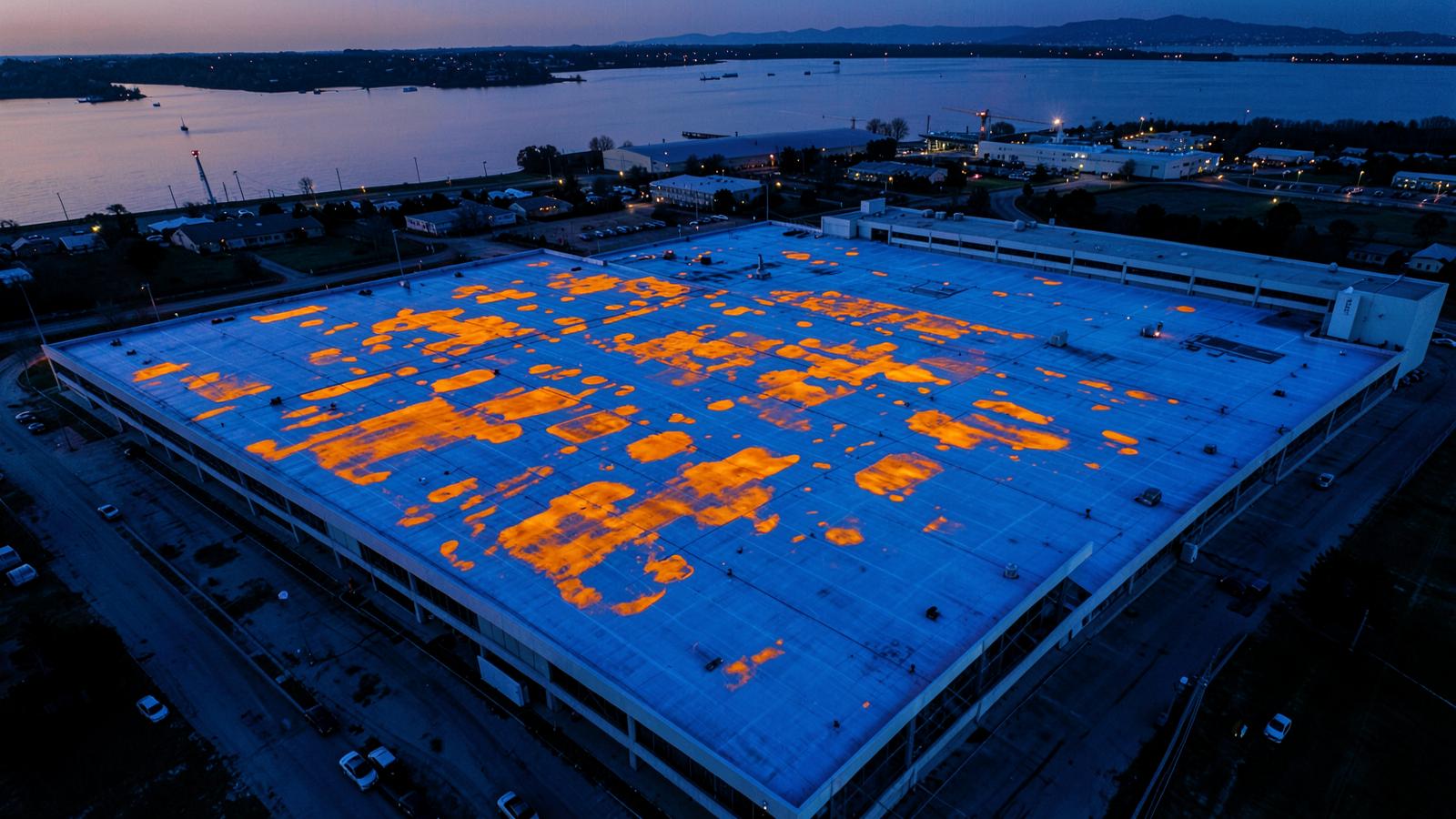
Find water inside the roof before it shows up on a ceiling.
Drone cameras and aerial mapping that find trapped moisture in commercial flat roofs. No cutting required, and every finding is measured and documented.
Most commercial roofs fail from the inside out. Water gets in through one small break, soaks the insulation under the membrane, and spreads quietly for seasons before a tenant ever reports a leak. A drone thermal moisture survey makes that hidden damage visible. After sunset, wet insulation holds onto heat while dry areas cool off, and a thermal (heat-sensing) camera maps the difference across the whole roof at once. P91 Roofing does not own this equipment. We partner with thermal imaging specialists and bring them in when a roof needs it, then turn the results into a clear roofing decision. We coordinate these surveys throughout The Woodlands, Conroe, Spring, Tomball, Magnolia, and greater Houston.
 P91 Zero-Leak Guarantee
What we deliver
- A no-cut heat scan flown by our imaging partner — no disruption to your building
- Full-roof coverage in one flight, including areas unsafe to walk on
- A detailed aerial map with measurable square footage
- Problem spots confirmed with moisture readings or core samples
- Wet vs. dry percentages to help plan your budget
- Fully insured crews, 5-year workmanship warranty on repairs
How infrared finds what a walk-through misses
Dry insulation releases the sun's heat quickly. Insulation holding water does not — it stores much more heat and gives it off for hours after sunset. Flying during that window, a thermal camera shows wet areas as clear warm spots against a cooler roof. A visual check from the roof surface only sees an intact membrane on top, which is why moisture problems often go unnoticed and unbudgeted until the roof deck itself is damaged.
Aerial mapping turns findings into measurements
Thermal images alone tell you something is wrong. Paired with a to-scale aerial map, they tell you exactly where and how much. Our imaging partner stitches hundreds of overlapping photos into one accurate map with the heat problem areas marked on top, and we report each area in square feet. Repair bids built from that map are easy to compare, because every contractor is pricing the same measured area.
Verification keeps the report honest
Standing water, HVAC exhaust, and shadows from ponding water can all look like trapped moisture on a heat scan. We confirm sample areas with a moisture meter, and when an area is large enough to change our recommendation, we take a small core sample and patch it the same visit. A survey that hasn't been confirmed this way is just a picture, not proof.
What the results change about your budget
If less than about a quarter of the roof is wet, removing and replacing just those sections, plus adding a restoration coating, is usually the cheaper option and adds real years of life. Past that point, replacing the whole roof is usually cheaper over the next ten years than chasing water that keeps spreading. The survey tells you which side of that line your roof is on, before an emergency makes the decision for you.
Baseline surveys and storm documentation
Scanning the roof when you buy a building, when a warranty ends, or right after a hail storm creates a dated record. If you file a claim later, that record shows what the roof looked like before and after the event. It's the most useful piece of evidence you can have in a disputed commercial claim.
What the survey delivers
- Aerial orthomosaic
- A detailed, to-scale map of the whole roof, showing accurate square footage, vent and pipe counts, and measured repair areas.
- Thermal moisture map
- Every problem spot is outlined, measured, and marked on the map, so a crew can find it without guessing.
- Verification readings
- We confirm sample problem spots with a moisture meter or a small core sample. This makes sure the report shows real trapped water, not just heat patterns that look similar.
- Wet vs. dry square footage
- The number ownership actually needs: how much of the roof is damaged, shown as a percentage of the total area.
- Repair / restore / replace comparison
- Priced options with the reasoning behind each, ready for budget planning or an insurance claim.
FAQ
What is a commercial roof thermal moisture survey?+
It's a scan that finds water trapped inside the roof without cutting into it. Wet insulation holds heat longer than dry insulation. So after sunset, a thermal (heat-sensing) camera sees the wet spots glow warmer than the dry areas around them. P91 brings in a thermal imaging partner who flies a drone with a heat camera over the roof and maps every problem spot. We then confirm each finding with a moisture meter or a small sample cut from the roof.
Why fly a drone instead of walking the roof?+
A drone covers the whole roof in one pass, including edges and areas that are unsafe to walk on. The aerial photos are stitched together into one detailed, to-scale map. That means measurements, repair areas, and problem spots are accurate instead of just estimated.
When is the scan flown?+
A thermal scan needs a clear day followed by a dry evening. We fly after sunset, once the dry parts of the roof have let go of their heat but the wet areas haven't — usually one to three hours after dusk. If it rained in the prior 24 to 48 hours, we usually have to reschedule.
Does the inspection damage the roof?+
No, the scan itself does not damage the roof. If we need a small sample to confirm a large problem area, it's a small cut, and we patch it the same day.
What do we receive afterward?+
You get an aerial map of the roof, a thermal moisture map marking and measuring each problem spot, the square footage of wet versus dry areas, confirmation readings, and a recommendation comparing costs for repairing just the wet sections, restoring the roof, or replacing it fully.
Why does trapped moisture matter if the roof is not leaking yet?+
Wet insulation loses most of its ability to keep heat out, which raises your cooling costs. It also rusts steel decking and spreads further each season. Catching it early, while it's still a small area, is the difference between a quick repair and tearing off the whole roof.
Planning a commercial roof project?
We'll give you an assessment, a written condition report, and a budget plan you can take to ownership. Our crews are fully insured, and every job has a 5-year workmanship warranty.